Museum of Australian Democracy at Old Parliament House
Cart Icon Shop Support Icon Support Search Icon Search

MoAD and the Courtyard Cafe are open. Some exhibitions and rooms will be closed from September 2025 for essential building works. Learn more

Main navigation

Visit

What's on Getting here and parking Access Plan a school visit Group tours Food and dining Shop Map

Learn

School visits Digital excursions and events Professional development Activities and resources

Play

Play at home Play at the museum

Explore

Democracy Collection Stories Political cartoons

Support

Donate Partnerships Volunteer Donate to collection

About

Old Parliament House Board of Old Parliament House Reports, policies and plans Access to information Media Careers Venue hire Contact
Main mobile navigation

Visit

What's on Getting here and parking Access Plan a school visit Group tours Food and dining Shop Map

Explore

Democracy Collection Stories Political cartoons

Learn

School visits Digital excursions and events Professional development Activities and resources

Play

Play at home Play at the museum

Support

Donate Partnerships Volunteer Donate to collection

About

Old Parliament House Board of Old Parliament House Reports, policies and plans Access to information Media Careers Venue hire Contact
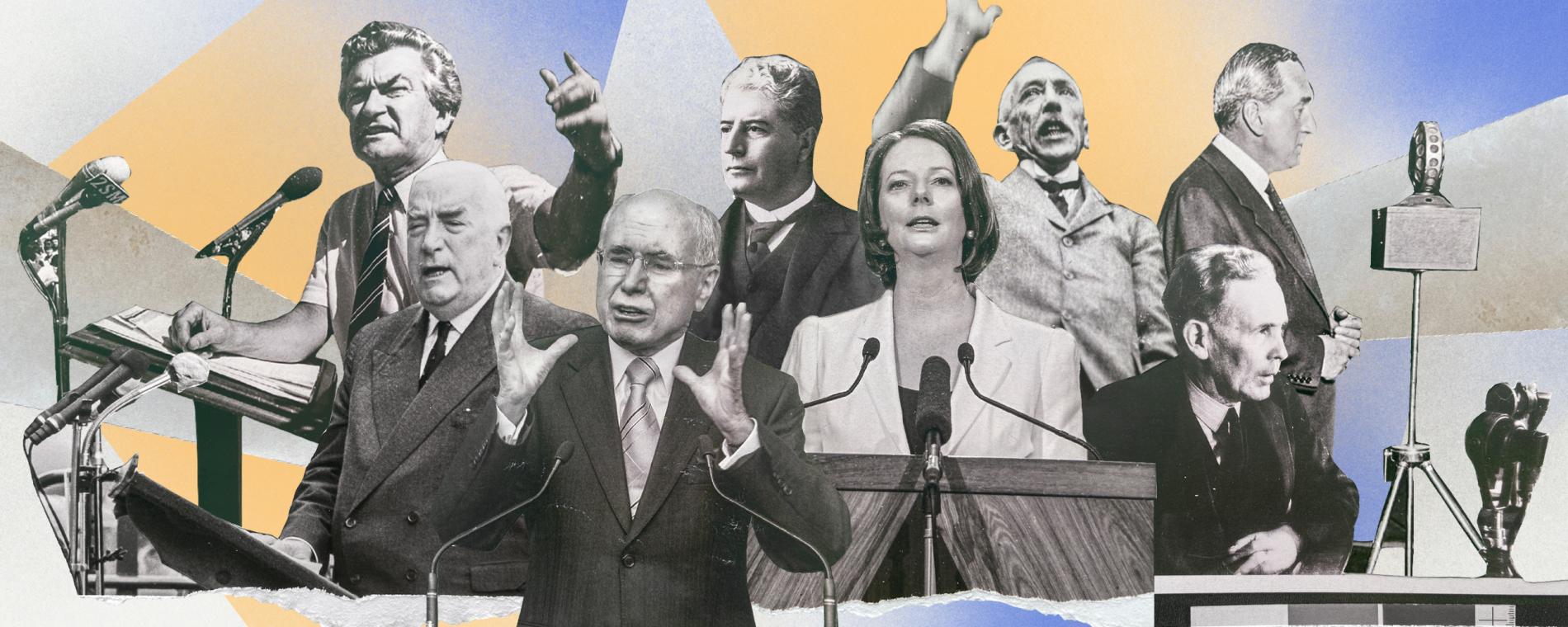
A collage graphic of prominent Australian politicians making speeches.
  • Home
  • Explore
  • Democracy
  • Election speeches
  • Search

Search results

  • communications and technology

Clear all filters

Showing 12 results of 19

Alfred Deakin – 1903
The responsibilities of this occasion are such that I shall not be able to spare you as I would otherwise desire tonight, because it will be my duty however imperfectly, though at some length, to call attention to the number and magnitude of the interests over which you have control. [Hear, hear] Having to make a choice between serious omissions, and perhaps wearisome prolixity, I have chosen the latter, remembering the admonition that of the two less grievous is the offence to tire your...
  • communications and technology
  • federal capital
  • federal-state relations
  • immigration
  • industrial relations
  • infrastructure
  • trade
  • White Australia policy
Andrew Fisher – 1913
Four years ago I delivered a policy speech at Gympie which outlined the proposals of the first Fisher Government for the safety and future progress of Australia. It awakened interest in Australian national questions, and then quickly followed the fusion of other political parties in the Federal Parliament, the defeat of the Labour Ministry immediately Parliament met, and the return of the Labour party to power at the last election. [Hear, hear] I am with you tonight to give account of my...
  • communications and technology
  • defence
  • economy
  • federal capital
  • federal-state relations
  • foreign affairs
  • health
  • industrial relations
  • infrastructure
  • social security
  • trade
  • White Australia policy
Billy Hughes – 1922
The Parliament elected by the people in 1919 has run its course; a new one has to be chosen; the Government to whom you then entrusted the reins of power again appeals to you for a renewal of your confidence. We have held office for nearly six years. As we have borne the heat and burden of the day during the most trying period in the history of the Commonwealth, it is only proper I should review our record, remind you of the principles for which we stand, and declare the polity upon which we...
  • agriculture
  • communications and technology
  • defence
  • federal capital
  • foreign affairs
  • health
  • immigration
  • industrial relations
  • water
  • White Australia policy
John Curtin – 1940
The country is at war. The Commonwealth of Australia entered this war, not of any act of itself, but because Germany, pursuing a ruthless policy of aggression, forced war on the British Commonwealth of Nations. The entire guilt lies with Germany. The Australian Labor Party stands inflexible in support of the British cause. We are upholding that which is just. We are struggling to maintain the democratic rights of our people and the free institutions of our nation against an enemy that has broken...
  • communications and technology
  • defence
  • infrastructure
  • social security
Robert Menzies – 1961
On December 9, though you will be voting for individual candidates, the end result will be that you choose a Government for the nation. I do not propose to put before you a long list of promises. After 12 years the A.L.P. can easily make a series of brand new offers without saying where the new hundreds of millions are to come from; though they will, of course, come from you. For governments have no money to spend except that which has been earned and paid over, by tax or loan, by the men and...
  • communications and technology
  • communism
  • defence
  • economy
  • education
  • employment
  • family
  • foreign affairs
  • health
  • immigration
  • Indigenous affairs
  • industrial relations
  • infrastructure
  • social security
  • socialism
  • trade
Robert Menzies – 1963
This is no ordinary election. It comes at a time when the Government has precariously and unexpectedly survived by one vote for two years. It comes at a time when turbulence and international tension exist nearer to our frontiers than ever before except during the last war; when strength is needed in the voice of Australia; when our country cannot afford to compel its Government to spend a lot of time, week by week, on the problem of domestic political survival. Why did I seek a dissolution? I...
  • communications and technology
  • communism
  • defence
  • education
  • family
  • foreign affairs
  • government administration
  • health
  • Indigenous affairs
  • industrial relations
  • infrastructure
  • social security
  • socialism
  • trade
Ben Chifley – 1949
Good evening listeners, The Commonwealth Labor Government brings to you, the electors of Australia, an account of its administration during the three years since you returned it to office; a review of how it has sustained the trust you gave to it when the call for national leadership went out in 1941; and its plans for the future, greater Australia. You will recall that in 1941 – after two years of war – the Liberal Party and Country Party coalition Government led by Mr. Menzies came to an...
  • agriculture
  • arts
  • communications and technology
  • communism
  • defence
  • economy
  • education
  • employment
  • family
  • health
  • immigration
  • industrial relations
  • infrastructure
  • social security
  • tourism
Arthur Calwell – 1963
The dissolution of the 24th Parliament of the Commonwealth was brought about one year ahead of time for reasons other than the false and spurious ones stated by the Prime Minister. There was no pressing national need for the Prime Minister and the Treasurer to precipitate this election and throw the House of Representatives and the Senate out of electoral alignment; and there can be no justification for the waste o£ £500,000 in having two elections where one alone next year would suffice. But...
  • communications and technology
  • defence
  • economy
  • education
  • employment
  • family
  • foreign affairs
  • health
  • immigration
  • Indigenous affairs
  • industrial relations
  • infrastructure
  • social security
Gough Whitlam – 1969
On 25 October Australians will elect a national government to take Australia into the 1970s. The campaign of the Australian Labor Party will have one dominant theme: the theme of opportunities, the taking of opportunities, the making of opportunities for Australia and for all Australians. We wish to renovate, rejuvenate, reinvigorate and liberate. It is not only time, more than time, for a change; it is time to refresh, remould and renew the whole framework of finances and functions and to end...
  • agriculture
  • communications and technology
  • defence
  • economy
  • education
  • environment
  • family
  • federal capital
  • federal-state relations
  • foreign affairs
  • health
  • Indigenous affairs
  • industrial relations
  • infrastructure
  • social security
  • trade
  • water
Gough Whitlam – 1977
The task before us is to get Australia back to work, to give our young people, our unemployed, our small business people, our migrants a new hope – hope for decent jobs, hope in their future and the future of their country. The deepening economic crisis, the deliberately created unemployment call for bold, decisive measures. I shall be putting forward proposals to cut through, once and for all, the knot which ties unemployment and inflation. We reject the defeatism and despair which says to...
  • communications and technology
  • economy
  • education
  • employment
  • federal-state relations
  • health
  • Indigenous affairs
  • industrial relations
  • infrastructure
  • social security
Malcolm Fraser – 1980
Challenges Tonight, I want to talk to you about the challenges and opportunities that lie before us. First, we must maintain responsibility in economic affairs because, without that, all else fails. Second, we must harness this nation’s resources in a co-ordinated and responsible programme of national development. Third, we must see that from the prosperity we generate, we provide adequately for those in need. Fourth, as individuals and as a nation, we must encourage ability and cultivate...
  • arts
  • communications and technology
  • defence
  • economy
  • family
  • foreign affairs
  • health
  • immigration
  • Indigenous affairs
  • industrial relations
  • infrastructure
  • social security
Bob Hawke – 1984
My fellow Australians, When from this place in February 1983 I first asked for your support, I sought from you an act of great trust. Our nation was then in deep crisis – the worst economic crisis for more than fifty years, and a searing crisis of the national spirit, after a decade of confrontation and division. Unprecedented circumstances demanded unprecedented responses. Therefore, on behalf of the Australian Labor Party, I asked for your support, your co-operation – and your active...
  • arts
  • communications and technology
  • crime
  • defence
  • economy
  • education
  • employment
  • environment
  • family
  • foreign affairs
  • health
  • Indigenous affairs
  • infrastructure
  • social security
  • women

Pagination

  • Current page 1
  • Page 2
  • Next page Next ›
  • Last page Last »

Discover patterns in political speech

Explore how language in Australian election speeches has evolved – from the rise of terms like internet and terrorism, to shifts in readability and speech length over time.

Footer

Stories, ideas and news in your inbox

02 6270 8222 info@moadoph.gov.au
  • Facebook
  • Instagram
  • Twitter
  • Youtube

Visit

  • What's on
  • Getting here and parking
  • Access
  • Food and dining
  • Plan a school visit
  • Group tours
  • Shop
  • Map

About

  • Old Parliament House
  • Board of Old Parliament House
  • Reports, policies and plans
  • Access to information
  • Media
  • Careers
  • Venue hire
  • Contact

Learn

  • School visits
  • Digital excursions and events
  • Professional development
  • Activities and resources

Support

  • Donate
  • Partnerships
  • Volunteer
  • Donate to collection

Play

  • At the museum
  • At home

Explore

  • Democracy
  • Collection
  • Stories
  • Political cartoons

The Museum of Australian Democracy acknowledges Australia's First Nations peoples as the Traditional Custodians of Country throughout Australia. We recognise their continuing connection to land, waters and community. We respectfully acknowledge the role that First Nations people continue to play in shaping Australia's democracy. We also acknowledge the Ngunnawal, Ngunawal and Ngambri peoples as the Traditional Custodians of the region in which MoAD is located. Aboriginal and Torres Strait Islander people should be aware that this website may contain images, voices and names of deceased people.

© Copyright 2026 Museum of Australian Democracy at Old Parliament House Privacy Statement

MOAD house logo